Short answer: A SOAP note is the standard four-part format for clinical documentation: Subjective (what the patient reports), Objective (measurable findings), Assessment (the clinician's interpretation), and Plan (what happens next). Below: what belongs in each section, a copy-paste template, worked examples, and the mistakes instructors flag most. This is a documentation-writing guide for students and professionals — educational content, not medical advice.
← Back to Blog
SOAP Notes: Format, Template, and a Worked Example
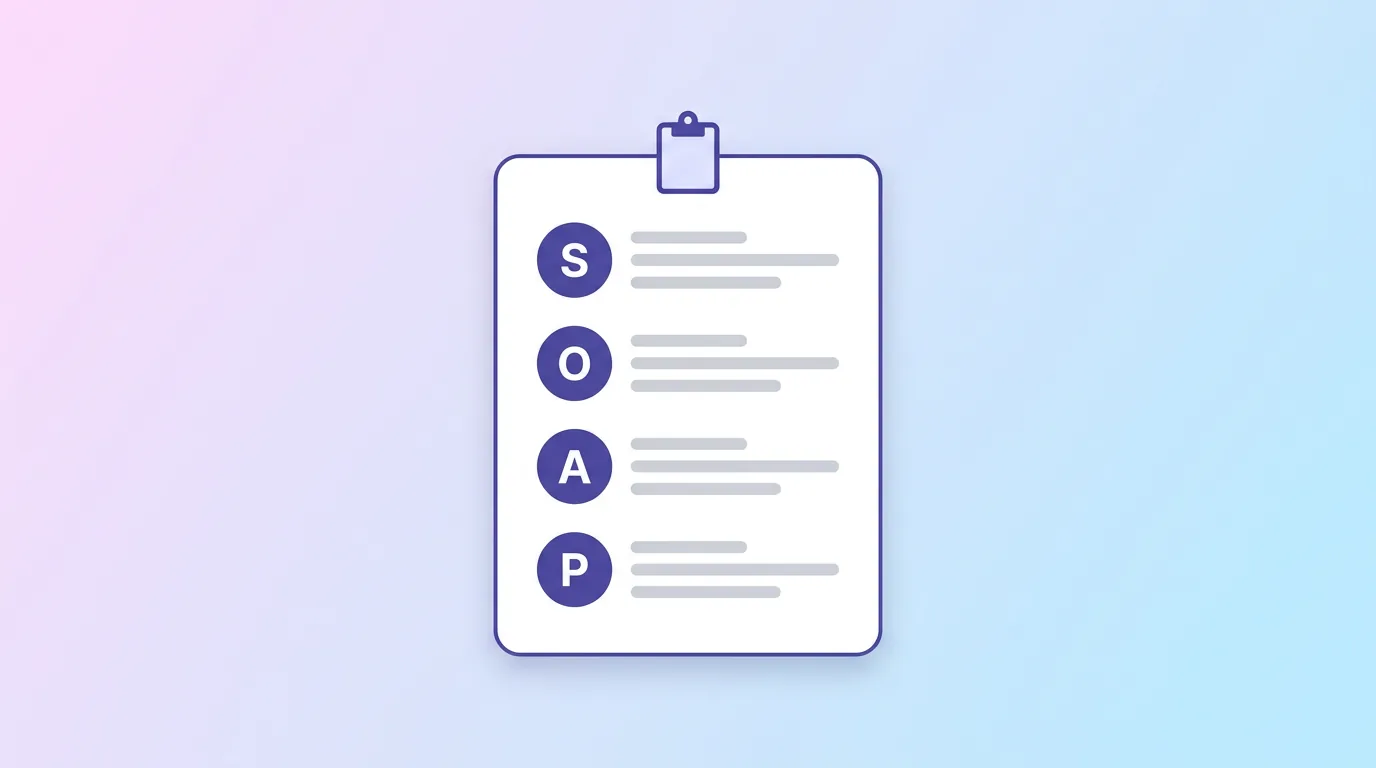
SOAP has survived since the late 1960s (it grew out of Dr. Lawrence Weed's problem-oriented medical record) because it forces a clean separation between what was reported, what was observed, what you conclude, and what you'll do. Nurses, physicians, therapists, PTs, dietitians, and counselors all use it — with local flavors, but the same skeleton. Here's the whole format, practically.
S — Subjective: what the patient tells you
The patient's own report, in their frame: chief complaint, history of the present issue, symptoms, concerns, relevant history they volunteer. Quote sparingly but precisely when wording matters ("chest tightness when climbing stairs, started Tuesday"). What does NOT belong here: your interpretations. "Patient reports feeling dizzy since morning" is subjective; "patient is dehydrated" is not — that's assessment wearing the wrong hat.
O — Objective: what you can measure or observe
Vitals, exam findings, test results, observable status — anything another clinician could verify: "BP 132/84, HR 78, afebrile. Mild swelling in the left ankle; full range of motion; gait steady." The classic student error is smuggling opinion in ("patient seems anxious") — if it's an observation, describe the observable ("patient fidgeting, speech rapid").
A — Assessment: what you conclude
Your professional interpretation of S + O: the working diagnosis or problem list, changes since the last note, and your reasoning where it isn't obvious. In multi-problem patients this section is often a numbered problem list, each with a one-line status ("1. Type 2 diabetes — improved control, A1c down from 8.1 to 7.2").
P — Plan: what happens next
Concrete next steps, per problem where applicable: treatments started or adjusted, tests ordered, referrals, patient education given, follow-up interval. A reader should be able to execute your plan without asking you anything — that's the test of a good P.
Copy-paste SOAP template
| Section | Prompts to fill |
|---|---|
| Subjective | Chief complaint · onset/duration · symptoms in the patient's words · relevant reported history |
| Objective | Vitals · exam findings · test/lab results · observable status |
| Assessment | Working diagnosis or problem list · status vs. last visit · reasoning if non-obvious |
| Plan | Treatment changes · orders/tests · referrals · education given · follow-up interval |
A worked example (primary care)
S: 46-year-old reports intermittent headaches for 2 weeks, "pressure behind the eyes," worse in the afternoon. Denies visual changes, nausea. Reports increased screen time and poor sleep since starting a new job.
O: BP 128/82, HR 72, afebrile. Neuro exam unremarkable. No sinus tenderness. Visual acuity unchanged from record.
A: Tension-type headache, most consistent with lifestyle factors (screen exposure, sleep debt). Low suspicion for secondary causes given normal exam.
P: Sleep hygiene counseling provided; recommend screen breaks (20-20-20). OTC analgesic as needed, max 3 days/week. Return in 4 weeks or sooner if new symptoms (visual change, worst-ever headache) — red flags reviewed with patient.
Discipline-specific examples — therapy, nursing, counseling — live in our companion piece: SOAP note examples by discipline.
The mistakes instructors flag most
Mixing S and O ("patient is in pain" — reported or observed?). Assessment that just repeats data — A is your interpretation, not a summary of O. Vague plans ("continue monitoring" — of what, how often, until when?). Novel-length subjectives — S is a filtered account of what's relevant, not a transcript. Copy-forward drift — reusing yesterday's note until it no longer matches today's patient; every section must be true today.
SOAP's cousins: DAP, BIRP, and friends
Behavioral health often uses DAP (Data, Assessment, Plan — S and O merged) or BIRP (Behavior, Intervention, Response, Plan — centered on the session's interventions). If your program or workplace mandates one, the skills transfer: the same separation of observation from interpretation from action powers all of them.
Frequently Asked Questions
What does SOAP stand for?
Subjective, Objective, Assessment, Plan — the four sections of the standard clinical note format: what the patient reports, what you measure or observe, what you conclude, and what happens next.
What's the difference between Subjective and Objective?
Subjective is reported (by the patient or caregiver); Objective is measured or directly observed by the clinician. "Says she's been feverish since Sunday" is S; "temperature 38.4°C" is O.
How long should a SOAP note be?
As short as completeness allows. A routine follow-up can be a few lines per section; complex visits run longer. The test isn't length — it's whether another clinician could pick up care from your note alone.
What's the difference between SOAP and DAP notes?
DAP merges Subjective and Objective into a single Data section — common in counseling and behavioral health, where the reported/observed line blurs. Assessment and Plan work the same in both.
Related reading
Turn this into action with CraftNote
Record meetings and lectures, then get AI transcripts, summaries, and action items.
Try CraftNote free