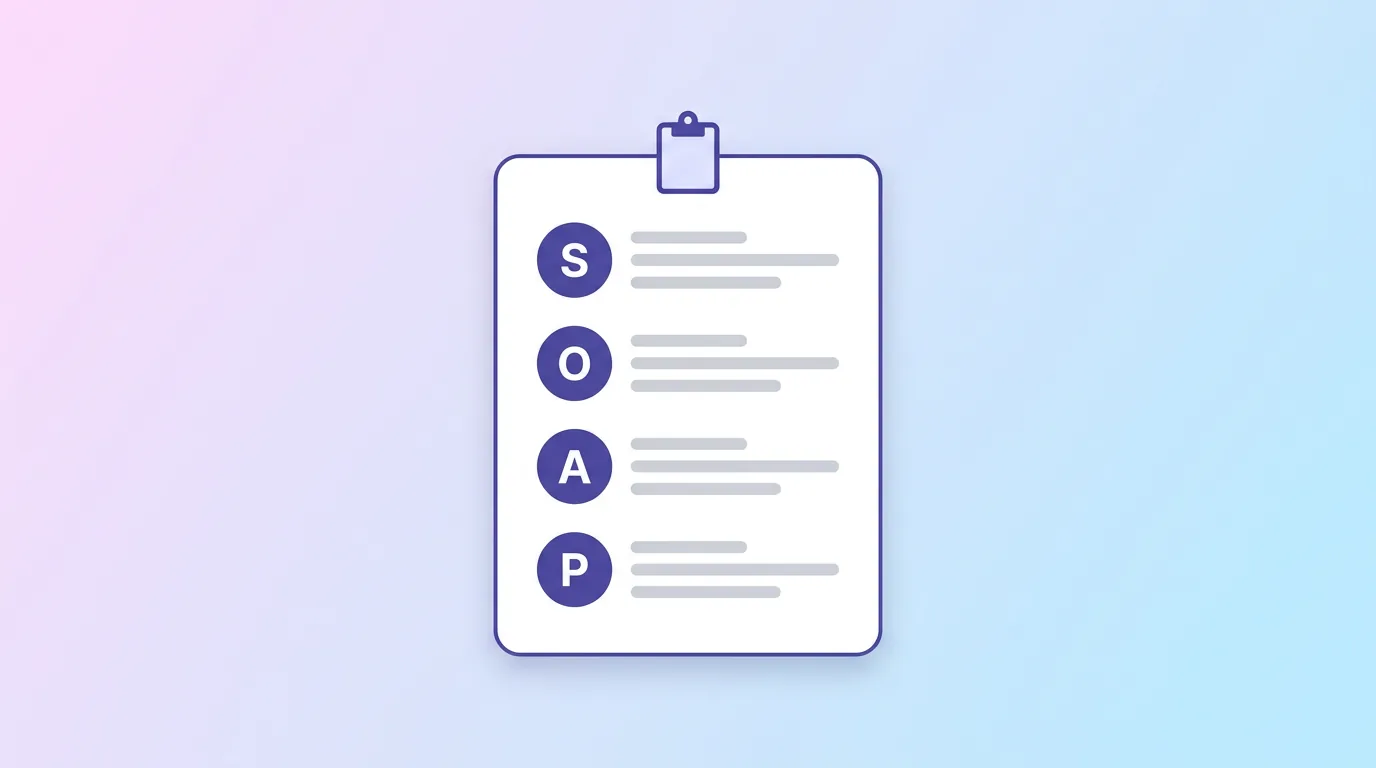
Short answer: Below are complete SOAP note examples for the disciplines that use the format most: therapy/counseling, nursing, and physical therapy, plus a quick-reference of what changes between fields. Same four sections everywhere (Subjective, Objective, Assessment, Plan); what shifts is what counts as "objective data" and how the plan is phrased. Educational examples for documentation practice: details are fictional, and this is not medical advice.
← Back to Blog
SOAP Note Examples: Therapy, Nursing, and Physical Therapy

If you're new to the format itself, start with our SOAP notes guide and template; this page is the example library. Each example is written the way instructors ask to see them: specific, separated, and executable.
Therapy / counseling SOAP note example
S: Client reports "a better week than last," rating mood 6/10 (up from 4/10). States she used the breathing exercise before two work presentations and "got through both without leaving the room." Reports one difficult evening after a phone call with her mother; describes rumination lasting "a couple of hours."
O: On time; groomed appropriately. Engaged throughout; maintained eye contact. Affect brighter than previous session; congruent with reported mood. Completed thought-record homework 4 of 7 days.
A: Progress toward treatment goal #1 (anxiety management in work settings): client independently applied coping skill in two trigger situations. Family-related rumination remains an active stressor; homework adherence improving.
P: Continue weekly CBT. Introduce cognitive-restructuring worksheet targeting family interactions. Homework: thought record daily, plus one behavioral experiment (initiating a boundary-setting statement). Next session in 7 days.
Nursing SOAP note example
S: Patient reports incision pain 4/10, "sharp when I stand up," relieved to 2/10 with prescribed analgesic. Reports passing gas this morning; no nausea. States she slept "in stretches" overnight.
O: Day 2 post-appendectomy. T 37.1°C, BP 118/76, HR 80, RR 16, SpO2 98% RA. Incision clean, dry, intact; no erythema or discharge. Bowel sounds present ×4 quadrants. Ambulated to hallway with standby assist ×1.
A: Recovering as expected post-op day 2; pain controlled on current regimen; early mobility on track. No signs of infection.
P: Continue scheduled analgesia; reassess pain q4h. Encourage ambulation TID. Advance diet as tolerated. Monitor incision each shift; educate patient on wound signs to report. Anticipate discharge planning discussion tomorrow.
Physical therapy SOAP note example
S: Patient reports knee stiffness "mostly in the morning," 3/10 during exercise, no swelling since last visit. Completed home program 5 of 7 days; reports stairs are "easier this week."
O: Left knee flexion 118° (prior 110°), extension full. Quad strength 4+/5. Single-leg balance 22s (prior 15s). Completed 3×10 step-downs with good control, minimal compensation.
A: Steady progress toward ROM and strength goals post-meniscectomy, week 5. Functional carryover evident (stairs). On track for projected discharge at week 8.
P: Progress resistance on leg press; add lateral step-downs. Continue home program with added single-leg balance progression. Re-measure ROM next visit; 2 visits/week × 3 weeks.
What changes between disciplines
| Discipline | "Objective" usually means | Plan emphasis |
|---|---|---|
| Therapy / counseling | Presentation, affect, engagement, homework adherence | Interventions, homework, session cadence |
| Nursing | Vitals, wound/line status, intake/output, mobility | Monitoring schedule, comfort measures, education, discharge prep |
| Physical therapy | ROM degrees, strength grades, functional test scores | Exercise progression, home program, visit frequency |
| Medicine (MD/NP/PA) | Exam findings, labs, imaging | Orders, prescriptions, referrals, follow-up interval |
What makes these examples "good"
Three habits worth copying. Numbers over adjectives: "flexion 118°, prior 110°" beats "improving mobility," because progress you can't measure is progress you can't defend. The S/O wall holds: everything reported stays in S, everything observed in O, even when they describe the same thing (patient says pain is 4/10 = S; grimacing on standing = O). Plans have owners and clocks: every P line answers what, who, and when: "reassess q4h," "next session in 7 days," "re-measure next visit."
Frequently Asked Questions
Are these real patient notes?
No. All examples are fictional, written for documentation training. They model structure and level of detail, not clinical guidance for any real case.
Can I use these SOAP examples as templates?
Yes, copy the section structure and replace the content. The companion guide includes a blank prompt-based template you can reuse for any discipline.
How detailed should the Subjective section be in therapy notes?
Selective, not exhaustive: capture mood/status ratings, notable quotes, and reports relevant to treatment goals. A session transcript is not a note: the note is the filtered, clinically relevant account.
Do nurses always chart in SOAP format?
Not always. Many facilities use flowsheets, narrative charting, or DAR (Data, Action, Response). SOAP remains the common teaching format and the default where problem-oriented notes are expected.
Related reading
Turn this into action with CraftNote
Record meetings and lectures, then get AI transcripts, summaries, and action items.
Try CraftNote free