Short answer: A good open house sign-in sheet collects five things: name, phone, email, "working with an agent?", and what the visitor is looking for. Below is a free template you can copy or print, a digital QR-code version, and the follow-up email that turns Sunday's signatures into Monday's conversations, because the sheet is worthless if the follow-up doesn't happen within 24 hours.
← Back to Blog
Open House Sign-In Sheet: Free Template + the Follow-Up That Makes It Work
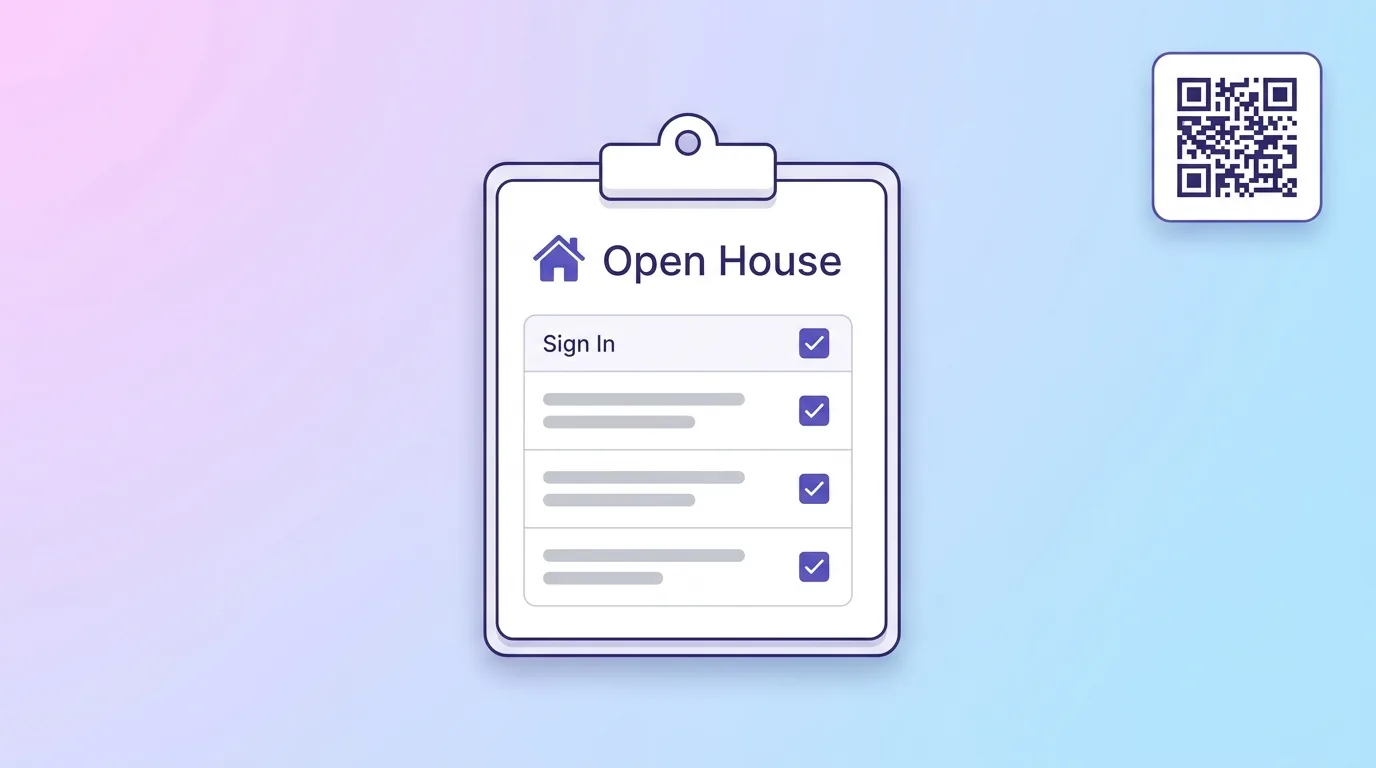
The sign-in sheet is the only thing an open house leaves behind. Buyers forget the address by Tuesday; the sheet is your claim on the conversation. Here's a clean template, what each field is for, and the system around it.
The template
| Name | Phone | Working with an agent? | What are you looking for? | |
|---|---|---|---|---|
| ☐ Yes ☐ No | ||||
| ☐ Yes ☐ No | ||||
| ☐ Yes ☐ No | ||||
| ☐ Yes ☐ No | ||||
| ☐ Yes ☐ No |
To print: copy this table into a doc, set the page to landscape, and give the last column real width: it's the one that earns its space. Add the property address and date at the top of each sheet so stacked sheets from different opens don't blur together.
Why these five fields (and not fifteen)
Name, phone, email are the floor, but ask for both phone and email and you'll usually get at least one honest channel. "Working with an agent?" is the qualifier: a yes isn't a dead end (their agent relationship may be loose), but it changes your follow-up from recruiting to nurturing. "What are you looking for?" is the field agents skip and shouldn't: one honest phrase ("3BR, needs a yard, school district matters") is the difference between a generic blast and a follow-up that reads like you listened. Longer forms depress completion; five fields is the ceiling before people start writing fake emails.
The digital version: a QR code beats a clipboard
A QR code taped next to the flyers, pointing at a short form (Google Forms works fine), gets you legible contact data that goes straight to a spreadsheet: no deciphering handwriting at 9 PM. Keep the paper sheet too: some visitors won't scan, and a clipboard by the door with a pen is a social cue that signing in is expected. Same five fields on both.
The 24-hour follow-up (where the sheet pays off)
Send it the same evening or next morning, while the house is still in their head:
Subject: Great meeting you at 14 Elm St
Hi [Name], thanks for coming through the open house today. You mentioned [the one thing they wrote/said: schools, the yard, the kitchen]. If [address] isn't the one, I know a few similar listings coming up in the area, so want me to send them over when they hit? Either way, happy to answer anything about today's house. Best, [You]
The bracketed personal line is the whole email. This is where capture quality shows: if you also record a quick voice debrief after the open ("couple in their 30s asked twice about the roof; investor wanted rent comps"), you have the personal line for every visitor. CraftNote turns that two-minute car-seat debrief into searchable notes with action items: showing-day memory that survives until follow-up time. Prompts for writing the rest of the email are in our ChatGPT for real estate agents guide.
Common mistakes
Making it optional-looking. Greet at the door, gesture at the sheet: "Would you sign in for the seller's record?" Framing it as for the seller raises completion. Asking for addresses. Visitors won't give them and the field spooks the rest of the form. Letting the sheet age. A Sunday sheet followed up on Thursday converts like a cold list, because the sheet's value has a 24-48 hour half-life. No debrief. The sheet captures who came; only you can capture what they cared about, and that memory fades by dinner.
Frequently Asked Questions
What should an open house sign-in sheet include?
Five fields: name, phone, email, whether the visitor is already working with an agent, and what they're looking for. More fields lower completion rates; fewer make follow-up generic.
Is a digital or paper sign-in sheet better for open houses?
Run both. A QR code to a short form gives you clean, legible data; the paper sheet catches visitors who won't scan and acts as a visible cue that signing in is expected. Use the same five fields on each.
How soon should I follow up with open house visitors?
Within 24 hours, ideally the same evening. Reference one specific thing each visitor said or wrote; that single personalized line is what separates your email from every other agent's blast.
Do visitors have to sign in at an open house?
No, and you can't force it, but framing it as a record for the seller's security and having the sheet visibly by the door with a greeter gets most visitors to sign. Expect a few fake entries; the honest majority is what you're there for.
Related reading
Turn this into action with CraftNote
Record meetings and lectures, then get AI transcripts, summaries, and action items.
Try CraftNote free